Kuala Lumpur Chinatown
Malaysia is built for adventure.
Spread out over two large regions, the lower half of the Malay Peninsula and the upper portion of the massive island of Borneo, Malaysia is characterized by towering mountains, dense jungles, and pristine beaches.
Add in the modern, cosmopolitan capital city of Kuala Lumpur, and you have endless opportunities for adventure, no matter your interests or tastes.
Due to its well-developed infrastructure and low crime rates, Malaysia is an overwhelmingly safe country. Still, as with anywhere in the world, don’t visit without travel insurance to Malaysia, especially if you plan on enjoying the more adventurous side of the country.

Kuala Lumpur
Exploring Kuala Lumpur
The large yet manageable metropolis of Kuala Lumpur is an excellent starting point for a longer adventure in Malaysia. There are many attractions in Kuala Lumpur that are worth exploring.
While the focal points of the city may be its two towering skyscrapers—the instantly recognizable Petronas Twin Towers and the newly built Merdeka 118, the second-tallest building in the world—Kuala Lumpur’s true charm lies at street level, in its many distinctive neighborhoods.
A unique mix of Islamic and colonial English architecture surrounds central Merdeka Square, also known as Independence Square, where mosques, traditional restaurants, and the Little India neighborhood are only steps away.
Around the corner is Chinatown, where you’ll find Hindu temples, night markets, and of course, a wide variety of Chinese restaurants, many with seating right on the street. Chinatown is also a good neighborhood to look for affordable hotels, such as the Travelodge, conveniently located next to the Pasar Seni train station.
Deeper into the city center is the bustling Bukit Bintang shopping district, where you can explore tiny shops in cramped alleys between ultra-modern shopping malls. Here you can pick up a bubble tea, get a foot massage, and then keep right on exploring.
Another important attraction in Kuala Lumpur is the Batu Caves, where colorful Hindu temples are constructed inside large limestone chambers, which, unlike most caves you might think of, go up instead of down.
In the Batu Caves, among tall statues of gods and goddesses, bats swarm overhead, and monkeys peer down from their cliffside perches, hoping to steal a snack from distracted tourists.
To truly enjoy Kuala Lumpur, put on your walking shoes, pack a bottle of water (it’s hot!), and set out to wander—something interesting is bound to appear around every corner.
Where to stay
Check out our reviews for the Royale Chulan in Kuala Lumpur.

Taman Negara Orang Asil
Visit an Orang Asli Tribe in Taman Negara
Located in the north of the Malay Peninsula, near the Thai border, the enormous Taman Negara National Park contains one of the oldest rainforests in the world.
Estimated to be around 130 million years old, Taman Negara is home to a great diversity of wildlife, including wild elephants and Indian bison.
There are even tigers, as one park ranger told me at a jungle canopy walk. He said that during the COVID pandemic, when the park was closed to tourists, groups of tigers ran daily through the ramps and bridges where I was now walking.
Taman Negara is also a birder’s paradise, and in fact, many visitors to the park come only to birdwatch.
A series of trails branches out from the park’s main entrance, but to go any deeper than the first loop or two, a qualified guide is required. This is a sprawling, ancient jungle, after all, and many more dangers besides tigers exist, not the least of which is getting lost.
Although you probably won’t get eaten by a tiger, less terrifying dangers exist in the Taman Negara, such as insect bites and dehydration. Being prepared doesn’t only mean bringing an extra bottle of water.
As much as I love hiking, the highlight of my guided trek into the Taman Negara jungle was our visit to a tiny village that’s home to one of the tribes of the Orang Asil people.
The Orang Asil, which comprises several distinct tribes, are descendants of the first settlers in Malaysia, and they more resemble (and are more closely related to) Australian Aborigines than modern Malaysians.
The friendly villagers welcomed our small group in their own language and then showed us some of their traditional crafts. The highlight was a demonstration of how to use a blowgun, which we all got to try out.
These are sophisticated, resilient people who have survived for millennia alongside elephants, tigers, and all the other jungle dwellers, thriving in a setting where you or I would be lucky to survive 24 hours on our own. Meeting them was a real privilege.

Climbing Mount Kinabalu
The jagged crown of Mount Kinabalu dominates the landscape of northern Borneo. It’s so iconic that it also features prominently on the flag of Sabah, the Malaysian state occupying the top part of the island.
Mount Kinabalu holds many records. It’s the highest mountain in Malaysia, the highest mountain in the islands of Southeast Asia, and the third-highest peak on an island anywhere on Earth.
So it’s no surprise that climbing Mount Kinabalu is popular, so much so that everyone who wants to do so must have a guide provided by the national park. The two-day climb includes a night in a bunk-bed shelter on the way up the mountain.
As you trudge up the slopes, take in the sweeping views of the surrounding countryside. Not because it’s especially dangerous—and whatever danger is certainly mitigated by the presence of your guide—but because it’s so remote.
Plus, Mount Kinabalu is very high, 4,095 meters (13,435 ft) above sea level, so altitude sickness is always a possibility, particularly if you spent the previous day or two on a beach.
Another consideration when climbing Mount Kinabalu is the season. The rainy season in Borneo is from November to February, and if you climb then, there’s a strong likelihood that your only view will be the inside of a cloud. So plan carefully for a trek up Mount Kinabalu.

Sepilok Orangutan
Searching for Orangutans in Borneo
Without a doubt, the most important symbol of Borneo isn’t a mountain, but an animal. Images of orangutans are painted huge in the corridors of each airport, hang on the walls of every travel agency, and appear on every map of the island.
You’re guaranteed an orangutan sighting—many, actually—in the Sepilok Orangutan Rehabilitation Centre, which is a must-visit attraction in Malaysia. Here, you’ll see orangutans swinging through the trees and eating fruit buffets at the Centre’s several feeding platforms.
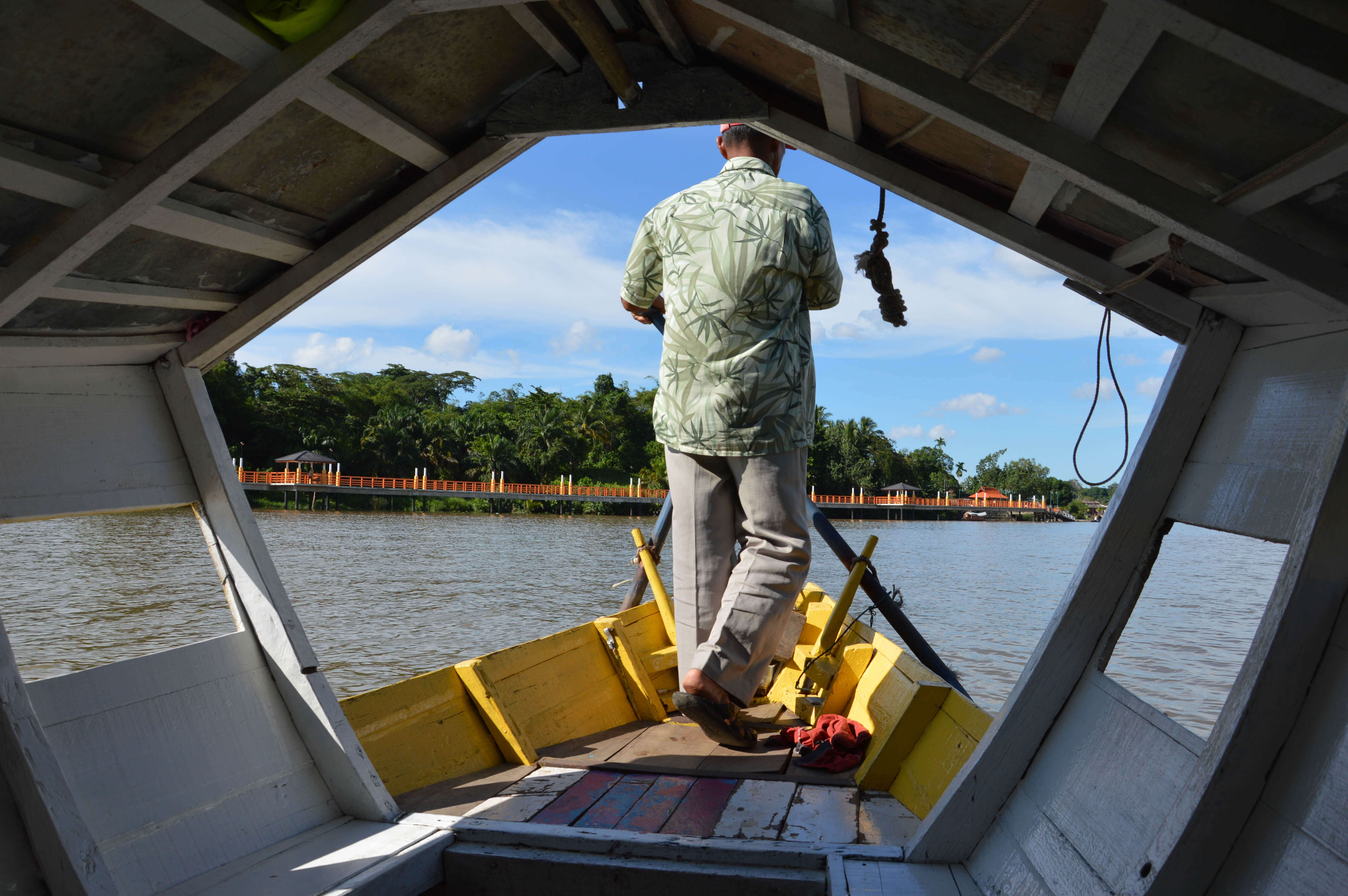
Sure, these aren’t exactly wild orangutans, although they aren’t caged, but are free to come and go as they please. For a glimpse of a wild orangutan, many travelers head a little farther south to the Kinabatangan River, where safari-like river cruises run every day.

Kinabatangan River
Even from the river, however, orangutan sightings aren’t common. My guide said that in a month of daily trips, he sees orangutans on only two or three days. Fortunately, we saw a few, but from very far away, high up in the trees.
Besides, there are many more animals to see, including hornbills, gibbons, and the aptly named proboscis monkey, whose bulbous snout makes it rival orangutans for frequent representation on promotional materials for Borneo.
Where to stay
For accommodation in Sepilok, take a look at the Sepilok Nature Resort, with its beautiful location on a lake surrounded by gardens. Even if you don’t stay there, I highly recommend you have a meal or two at its first-rate, open-air restaurant.

Malaysia dive boat
Scuba Diving in Sipadan
Off the northeast coast of Borneo, straddling the maritime border with Indonesia, lies the picturesque paradise island of Sipadan.
There are many great dive sites in Malaysia, but Sipadan is known by divers worldwide as not only one of the best in the country, but one of the best in the world.
The island was declared a marine park in 2004, and there are a limited number of daily permits for scuba diving available, so scuba diving in Sipadan requires some advance planning.
The rewards are plentiful. Along with turtles, barracuda, manta rays, and many kinds of sharks, one of the best-known reasons to scuba dive in Sipadan is its huge schools of big-eye trevally, which attract divers from all over the world.
If during your Malaysian vacation you don’t have time to visit the somewhat remote island of Sipadan, don’t worry, there are plenty of other great dive sites in Borneo. Many are concentrated around the tip of Borneo in the far north, which also features gorgeous white-sand beaches.
You can even scuba dive right off Sabah’s low-key capital of Kota Kinabalu, which you might recognize as the starting point for the first season of Survivor.
The reefs next to Kota Kinabalu have suffered somewhat from overtourism, with some disheartening dead zones, but they’re still worth a visit, and you’ll be able to walk to the pier from your Kota Kinabalu hotel, instead of planning a circuitous trip across the island to get to Sipadan.
Of course, for activities like scuba diving in Malaysia, travel insurance is crucial, if not mandatory. Many dive centers will ask for proof of insurance before signing you up for a trip.
Where to stay
Kota Kinabalu has many good hotels, including the Hyatt Regency, which has spacious rooms, a sauna, and a swimming pool with sea views, and the Capital Hotel, a tried-and-true budget option with a nice Italian restaurant on the first floor.
Check rates for Hyatt Regency Kinabalu online at Expedia, Booking.com, Agoda.com, or Hotels.com.
Check rates for Capital Hotel online at Expedia, Booking.com, Agoda.com, or Hotels.com.

Sabah sunset
Plan Your Adventure in Malaysia
It should go without saying that there are many more possibilities for adventure in Malaysia other than these five activities.
For the days between adventures, there’s plenty else to do in Malaysia: sampling a diverse cuisine whose native flavors have been heavily influenced by Indian, Chinese, and other styles; visiting world-class museums, such as the Islamic Arts Museum in Kuala Lumpur; and getting to know Malaysia’s friendly, welcoming people, many of whom speak English.
All in all, Malaysia is a relatively easy and stress-free country to travel in. So, enjoy your adventures in Malaysia, and make sure you always have the right coverage.